Monday, April 30, 2007

Basque Shepherd Dog


The Basque Shepherd Dog (Basque: Euskal artzain txakurra) is a breed of dog originating in the Basque Country and traditionally used by the local shepherds to help them taking care of the cattle. It is believed that originated from Central European shepherd dogs.

These dogs are well proportioned, with strong, rectangular bodies and trotter features. They are well covered with a typical coat of gold or copper rustic hair, longer over the trunk than over the head, which never covers the eyes. The relation between height and length is about 1/1.2.

Barbet (dog)


Appearance

The breed stands 58 to 65 cms for the males in height, 53 to 61 for the females with a tolerance of 1 cm +/- and weighs 17 to 28 kg. The Barbet is a prototypic water dog, with a long, woolly coat that is more curly than wavy. Colours of the breed are black, chestnut, fawn, grey, and white, with or without markings; mixed colours are not common. A litter was born in January 2007 with white and black, and white and brown puppies in Canada. Last FCI standard change: 2/06

Temperament

The Barbet’s personality is described as companionable, joyful, obedient and intelligent. they are capable retrievers for waterfowl hunting and a faithful companion.

History

The Barbet is thought to be the original source of the various water dog breeds (Poodle, Portuguese Water Dog, American Water Spaniel, and so on). His actual origin is lost in antiquity but probably stems from corded herding stock and perhaps griffon hounds. The breed is little known outside of France.

A breed club in the USA is affiliated with the Club des Chiens d'Eau in France and offers a US-based registry service. The United Kennel Club also registers the breed.

Austrian black and tan hound

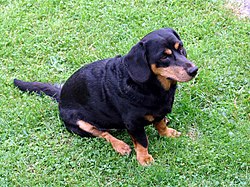
The Austrian Black and Tan Hound is a breed of dog originating in Austria. It is thought to be the true descendant of the original Celtic Hound, although there is no known history of the Austrian Black and Tan Hound until after the middle of the 19th century. This large sized hound was used for tracking wounded game, most commonly hare, in high altitudes.

Colouring in this breed is highly important; they must be black with small, clearly defined, light to dark fawn markings. Two fawn marks above the eyes must be present. The coat is smooth, dense and short (about 2cm in length). The long tail is slightly bent and the ears are medium in length and lie flat with rounded tips Height range from 48-56cm (19-22in).

Austrian Pinscher


The Austrian Pinscher is a breed of pinscher-type dog developed to drive and guard livestock; dogs much like these can be found in paintings from around the 18th century. They are also talented rat catchers and often lived in and guarded farmers' homes. This breed is distantly related to the German Pinscher. They do not get along well with other dogs and can have a tendency to bite.
Appearance

The Austrian Pinscher is a medium sized breed which has a short dense coat that comes in a variety of colours. The head is somewhat pear shaped and they can weigh between 12 - 18kg (20-40lbs). They stand 36-51cm (14-20in) to the withers.

Ariegeois


The Ariegeois is a breed of dog, specifically a French pack-hunting scenthound developed late in the last century. Distinguished by its friendly nature with other hounds and affection for human companions.

Alpine Dachsbracke


The Alpine Dachsbracke, known in its native country of Austria as Alpenlandische Dachsbracke, is a small breed of dog of the scent hound family, bred to track wounded deer as well as boar, hare, and fox. It is highly efficient at following a trail even after it has gone cold. Its ancestry can be dated back to the middle of the 19th century. It contains the blood of very old strains of hounds including the Austrian black and tan hound as well as that of the Standard smooth haired Dachshund. It once was a favorite of German royalty.

Appearance

This small dog has a slight resemblance to a Dachshund, with short legs (although longer than a dachshunds) and a long body. The coat is dense, short but smooth except for the tail and neck. The round eyes have a lively expression.

Valid colors are black and tan, brown, with the most popular being red with or without black.

It weighs from 15 to 18 kg (33 to 40 lb) and stands from 34 to 42 cm (13 to 16 in) at the withers.

Temperament

Used effectively to hunt wounded deer, this breed could work even in harsh terrain and high altitude. It makes a good companion, although it is primarily a hunter and therefore is kept mostly by hunters. It has a fearless, friendly and intelligent personality. Most Alpine Dachsbrackes are excellent with children and good with dogs and other pets, though they may exhibit a strong prey drive typical of many scent dogs.

Alano Español


Alano Español or Spanish Bulldog this Spanish breed of dog that derives its name from the Alans. Recently received recognition from the Spanish Ministry of Agriculture and the RSCE. Recognition with the FCI is rumoured to be in planning[citation needed].

Description

The Alano Español has an untrained appearance that fits him especially for running long distances at high speeds and herding cattle. This dog has a well proportioned body structure, the rib cage is arched, but not cylindrical, the chest stretches to the elbow level. It also has strong and solid shoulders and withers. The back legs are weaker than the front legs, and are straight if you view them from the front or the side. The paws are big compared to the size and weight of the dog. The muscles in the hindquarters are toned and the back legs show very well defined angles with strong feet at the base. The tail is thickest at the base and gets thinner, eventually to a point. The stomach retracts inward in order to give him a more athletic appearance than other heavier breeds. The neck is strong, powerful and wide, showing two double chins that should never hang to low. The Alano has extremely powerful jaws. The teeth are wide, and spaced out from each other with a very strong and firm scissors bite. When running at full speed, they are fast and flexible, fully stretching in and out their whole body in each step. They can clear almost any obstacle without looking tired at all. Coat colors include yellow and wolf gray, fawns and reds.

Affenpinscher


Quick Facts

Affenpinscher Quick Facts

Weight: 3.1-3.6 kg 7-8 lbs
Height: 25 cm 10 inches
Coat: Rough & thick
Activity level: Very high
Learning rate: Medium to high
Temperament: Alert, quiet
Temperament (cont) inquisitive
Guard dog ability: Very low
Watch-dog ability: Very high
Litter size: 2-3
Life span: 14-15 years

Appearance

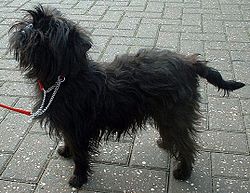
Weighing 7 to 9 pounds (3-4 kg) and not exceeding 11 inches (24-30 cm) in height at the withers,[1] the Affenpinscher has harsh rough coat and a monkey-like expression (Affe means monkey in German). Its coat is shaggier over the head and shoulders forming a mane, with shorter coat over the back and hind quarters. It is harsh and wiry in texture. The FCI and UK breed standards specifies that the coat must be black,[1][2] but the AKC also allows gray, silver, red, black and tan, and belge (not beige; belge is a mixture of red, black and white hairs);[3] other clubs have their own lists of acceptable colours, with black being the preference.

Temperament

Affenpinschers have a distinct appearance that some associate with terriers. They are different from terriers, however, in that they are actually part of the pinscher-schnauzer subgroup of group 2 in the FCI classification so often get along with other dogs and pets. They are active, adventurous, curious, and stubborn, but they are also fun-loving and playful. The breed is confident, lively, affectionate towards family members and also very protective of them. This loyal little dog enjoys being with its family. It needs consistent, firm training because some can be quite easy to housebreak. The training should be varied because the dog can easily become bored.

Affenpinschers are somewhat territorial when it comes to their toys and food, so they are not recommended for very small children. This dog is mostly quiet but can become very excited if attacked or threatened and shows no fear toward any aggressor. It is best suited for a family who likes a show and has a sense of humor.

Health

The Affenpinscher can get hip dysplasia.[4] As with many small breeds of dog they are prone to collapsed trachea, which is best avoided by walking the dog with a harness instead of a collar. Cataracts are occasionally reported. [4]

History

The breed is German in origin and dates back to the seventeenth century. Its name is derived from the German Affe ("ape", "monkey") . The breed predates and is ancestral to the Griffon Bruxellois (Brussels Griffon) and Miniature Schnauzer.[5]

Dogs of the Affenpinscher type have been known since about 1600 but these were somewhat larger, about 12 to 13 inches, and came in colors of gray, black, fawn, black and tan, gray and tan, and even red. White feet and chest were also common. The breed was created to be a ratter, working to remove rodents from kitchens, granaries, and stables.

Care

Affenpinschers need to be groomed two to three times a week because of their 1 inch coat.